
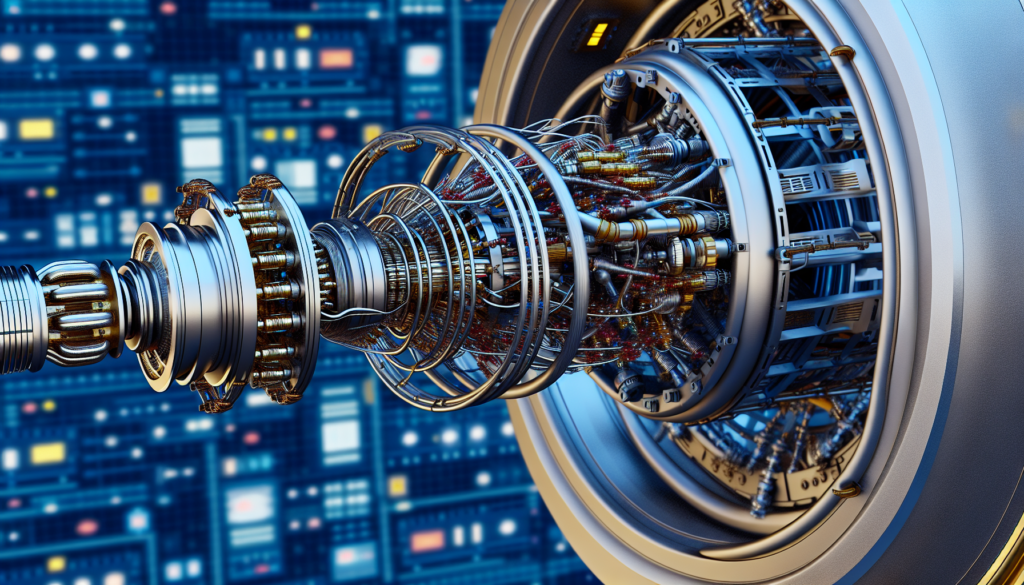
Warp drive is a theoretical propulsion system that enables spacecraft to travel faster than the speed of light by warping or bending space-time. This concept, popularized in science fiction, particularly in the “Star Trek” franchise, suggests that a spacecraft can create a bubble of distorted space around it, allowing it to move vast distances in a fraction of the time it would take using conventional propulsion methods.
The fundamental principle behind warp drive is based on Einstein’s theory of relativity, which states that nothing can travel faster than light in a vacuum. However, warp drive circumvents this limitation by manipulating the fabric of space itself rather than moving through it at superluminal speeds. The idea involves contracting space in front of the spacecraft while expanding it behind, effectively allowing the ship to ride a wave of space-time.
While warp drive remains a theoretical concept, scientists have explored its feasibility through various models, such as the Alcubierre drive, proposed by physicist Miguel Alcubierre in 1994. This model suggests that a spacecraft could achieve faster-than-light travel if it could generate negative energy density, a concept that is still largely speculative and not yet realized in practical terms.
Research in this area continues, with physicists examining the implications of warp drive technology and the potential for future interstellar travel. Although warp drive is currently beyond our technological capabilities, it inspires ongoing discussions about the possibilities of space exploration and the fundamental laws of physics. The quest for warp drive reflects humanity’s enduring desire to explore the cosmos and the limits of our understanding of the universe.
Warp drive is a theoretical propulsion system that enables spacecraft to travel faster than the speed of light by warping or bending space-time. This concept, popularized in science fiction, particularly in the “Star Trek” franchise, suggests that a spacecraft can create a bubble of distorted space around it, allowing it to move vast distances in a fraction of the time it would take using conventional propulsion methods.

The fundamental principle behind warp drive is based on Einstein’s theory of relativity, which states that nothing can travel faster than light in a vacuum. However, warp drive circumvents this limitation by manipulating the fabric of space itself rather than moving through it at superluminal speeds. The idea involves contracting space in front of the spacecraft while expanding it behind, effectively allowing the ship to ride a wave of space-time.
While warp drive remains a theoretical concept, scientists have explored its feasibility through various models, such as the Alcubierre drive, proposed by physicist Miguel Alcubierre in 1994. This model suggests that a spacecraft could achieve faster-than-light travel if it could generate negative energy density, a concept that is still largely speculative and not yet realized in practical terms.
Research in this area continues, with physicists examining the implications of warp drive technology and the potential for future interstellar travel. Although warp drive is currently beyond our technological capabilities, it inspires ongoing discussions about the possibilities of space exploration and the fundamental laws of physics. The quest for warp drive reflects humanity’s enduring desire to explore the cosmos and the limits of our understanding of the universe.













Leave a Comment
Your email address will not be published. Required fields are marked with *