
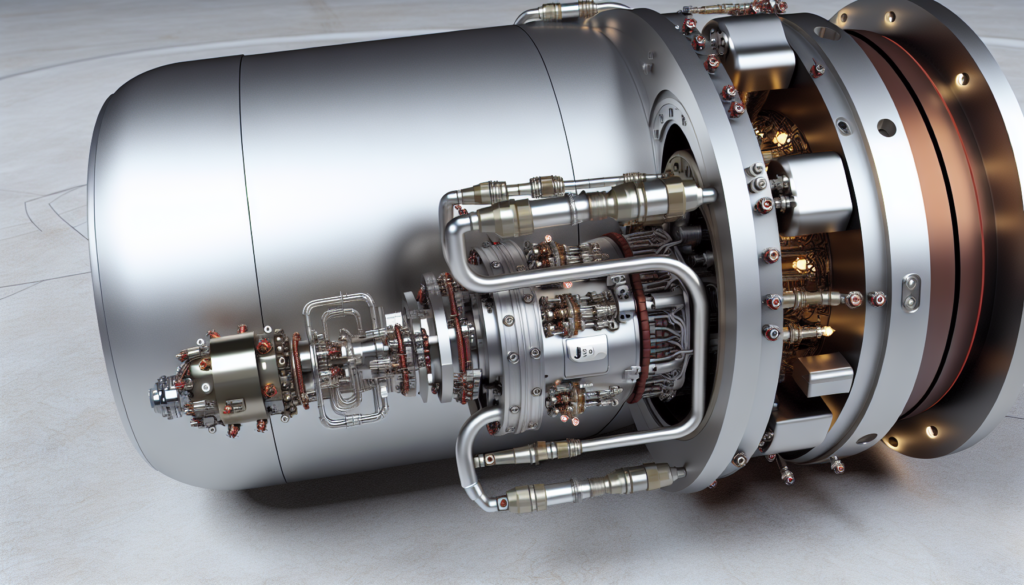
The Fusion Propulsion System represents a revolutionary advancement in space travel, promising to transform humanity’s ability to explore the cosmos. This innovative technology aims to harness the same nuclear fusion reactions that power the sun, enabling spacecraft to reach remarkable speeds and significantly reducing travel times to distant destinations. For instance, a mission to Mars could potentially be completed in weeks rather than months, vastly improving the feasibility of interplanetary exploration.
The core mechanism of the Fusion Propulsion System involves the fusion of light atomic nuclei, which releases immense energy. This process distinguishes it from traditional chemical rockets, offering a cleaner and more efficient means of propulsion. Central to the system’s operation is the creation and control of plasma, which is directed to produce thrust, propelling spacecraft at unprecedented velocities.
The implications of this technology extend far beyond mere speed; it could unlock the mysteries of our solar system and facilitate deeper space exploration. The Fusion Propulsion System is not merely a theoretical concept but a glimpse into a future where human ingenuity and advanced science converge to make the exploration of the stars a tangible reality. As we stand on the brink of this potential leap into the unknown, the call of the stars beckons humanity to embrace this next frontier in space travel.
Fusion Propulsion System: An Exploration of Advanced Space Travel Technologies
The prospect of human expansion into the cosmos, driven by the formidable energy of nuclear fusion, presents an unprecedented opportunity for advancements in space exploration. The Fusion Propulsion System represents a transformative technological innovation that could significantly alter the trajectory of interstellar travel.
The fundamental principle of this propulsion system lies in the ability to replicate the nuclear reactions that occur within the sun, specifically the fusion of light atomic nuclei. Such reactions result in the release of immense quantities of energy, which could enable spacecraft to attain extraordinary velocities, thereby drastically reducing travel durations to distant celestial bodies. For instance, a mission to Mars could potentially be completed in a matter of weeks, as opposed to the current estimates of several months.
The operational mechanism of the Fusion Propulsion System encompasses the generation and manipulation of plasma, which serves as the medium for thrust production. This process not only promises enhanced efficiency but also offers a cleaner alternative to conventional chemical propulsion systems, which are often limited by their environmental impact and fuel constraints.
The implications of harnessing fusion propulsion extend beyond mere efficiency; they may hold the key to unlocking the mysteries of the solar system and facilitating human exploration of outer space. As such, the Fusion Propulsion System emerges not merely as a theoretical construct but as a compelling vision for the future of human exploration and technological progress. The question remains: are we prepared to embrace this frontier and venture into the vast unknown of the universe? The call of the stars beckons humanity to respond.













Leave a Comment
Your email address will not be published. Required fields are marked with *